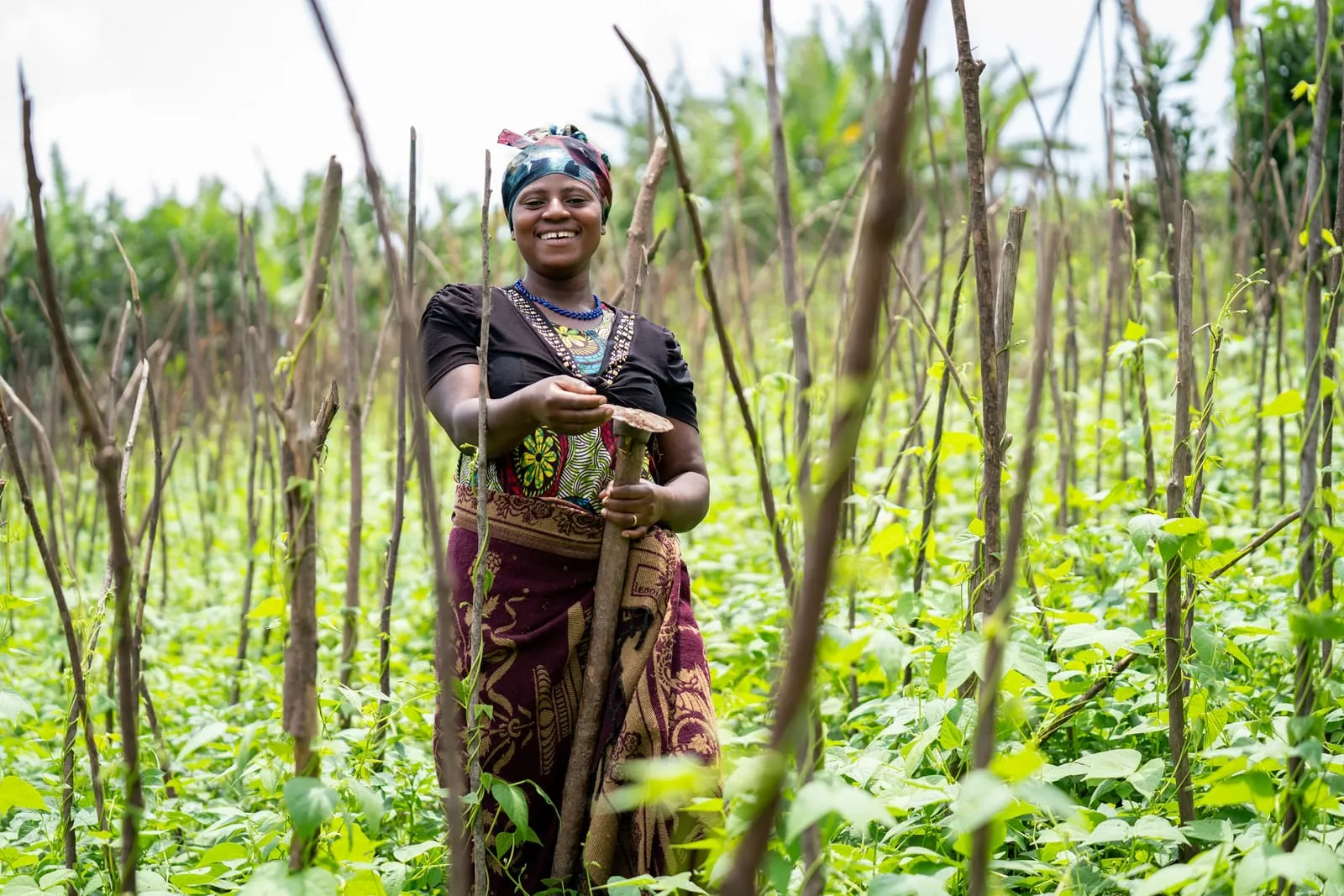
In rural villages where extreme poverty is widespread and hunger common, Raising The Village equips every household to grow more food and increase their income, at about a third of the cost of similar programs.
Our first program recommendation is Raising The Village. We’ll add more recommendations over time. Published: November 2026.
Raising The Village works in remote farming villages that have few roads, clinics, or services, where children and adults regularly go to bed hungry. Its program provides the resources and training for families to increase their harvests and their incomes.
In an independent randomized study of 335 villages, three years after the program began, households in program villages had 26% more income and 31% more wealth in livestock, savings, and household goods. In the months before harvest, when food from the last one runs low, 25% of households without the program reported a child going to bed hungry, versus 4% in program villages. For adults, the figures were 38% and 6%.
In 2027-2028, we estimate that a $27 donation will achieve the equivalent of doubling, for one year, what one person in a program village can provide for themselves: the food they grow and buy, and basics such as soap, clothing, fuel, school fees, and medical care.
Raising The Village at a glance
Where they work
4 countries
Uganda, Rwanda, Tanzania, and the Democratic Republic of the Congo
People reached
1 million
in 2026, and 3 million in total
419k
2024
647k
2025
1M
2026
Their vision
To “build and strengthen pathways out of ultra-poverty through an approach guided by data, designed with communities, and scaled by partnerships”
Cost-effectiveness
6x as cost-effective as giving cash directly
Raising The Village6x
Direct cash transfer1x
Impact per dollar donated
Estimated cost per consumption doubling
$27
The approach: poverty graduation
Raising The Village provides a form of poverty graduation, a type of program built on the premise that individuals and families remain in extreme poverty because they face several constraints at once. For instance, a family may have no money to invest, little access to training in farming or business skills, and no savings to absorb a setback, such as a failed harvest or an illness.
Graduation programs therefore address these constraints together, typically over one to two years, with the aim of households sustaining higher living standards after the program ends. Most combine several kinds of support.1 These typically include a grant of cash or a “productive asset” – goats, a sewing machine, stock for a small shop – to start or expand an income-generating activity like a farm or small business. They also include training in how to manage that asset or business, smaller transfers of cash or food to cover basic needs for the first few months to a year, regular coaching, and savings support.
The approach was pioneered in 2002 and is among the best-evidenced ways to reduce extreme poverty. In a recent meta-analysis of 40 randomized trials in 26 countries, graduation programs raised consumption (what a person eats and uses) by about 11%, income by 15%, and assets by 40% on average. Most trials measured effects up to four years after programs ended, and across them consumption gains were on average as large or larger at the later measurements.
Raising The Village’s program
Raising The Village works in remote farming areas in Uganda, Rwanda, Tanzania, and the Democratic Republic of the Congo. It brings the graduation approach to every household in a village. When the program begins, more than half of the households it works with live on less than $3 per person per day, the international line for extreme poverty. In plain terms, this is not what $3 buys after being exchanged into local currency. It is the amount of goods and services that $3 would have bought in the United States in 2021, covering all of a person’s needs for the day, including the value of food a household grows for itself.
Their program is structured as follows:
Pre-planning. Raising The Village selects villages in coordination with local government, and the program begins with a plan made in collaboration with the village. Staff survey households, ask residents to rank their needs, and identify seeds that match the local altitude, soil, and rainfall.
Core implementation (months 0–6). Households receive the seed packages. The village is also given farming equipment to share: for example, tools such as hoes, forks, and spades, and machines for milling grain, coffee pulpers, and spray pumps. Households attend training sessions covering topics such as agricultural practices, savings groups, and budgeting. The village also elects volunteer committees, including for agriculture, livestock, and sanitation, whose members receive extra training, mentor their peers, and look after shared equipment.
Transition (months 7–12). Each quarter, independent data collectors survey a sample of households. When fewer than 90% are using the skills covered during trainings, the village receives further training. Committee members visit every household on a fixed schedule to provide their peers with support.
Community ownership (months 12–24). Volunteer committees take over more of the day-to-day work, such as mentoring neighbors and managing shared tools. Staff shift from delivery to mentoring and then handover, providing refresher trainings where the data show a need. At month 24, the village graduates.
Follow-up (months 25–60). Program activity ends. To inform future program design, Raising The Village surveys a sample of households each year until five years after the start of the program to track metrics including income, production, assets, and food security.
Raising The Village stands out for its combination of impact and cost-effectiveness. In its randomized trial, it had the lowest cost of any program in the meta-analysis mentioned above, yet its effects were comparable with those of the other programs.
Raising The Village is an exceptionally data-driven organization. Each year, after the main harvest, it surveys a random sample of households in every village on their income, harvests, and food supply, and runs the same survey in similar villages where it does not work. Its leadership reviews program data every quarter and decides on changes for the next one. For example, when the data showed that households were earning little from perennial crops such as coffee, it added training in growing them. When the data showed that larger harvests were not reliably becoming higher incomes, because households sold on their own at low prices, it introduced selling as a group.
A participant’s story
Alex, Rubanda District, Uganda
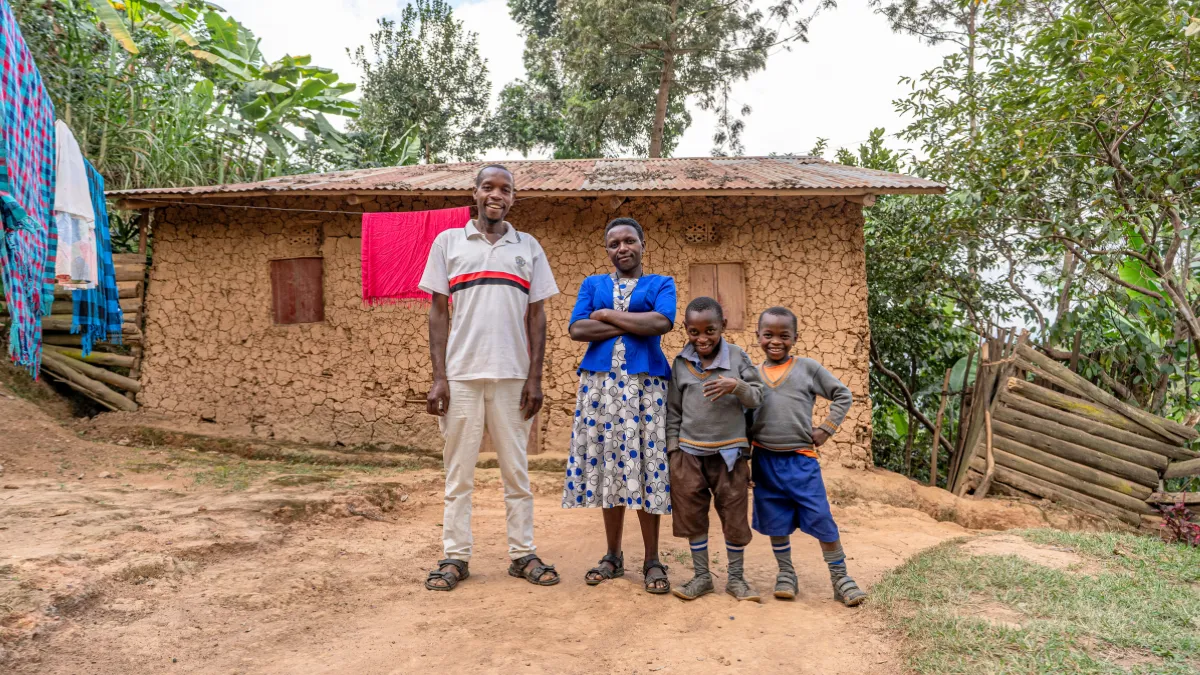
Alex farms potatoes on steep slopes near Bwindi Impenetrable National Park, with his wife, Precious, and their two children.
His village joined the program in early 2025. Alex learned to make his own compost and fertilizer, and changed how he plants. He says 80 kg of seed potatoes used to yield about 100 kg; now 40 kg yields about 300 kg. With savings and credit from his savings group, he began trading sheep and pigs, and now owns 12 sheep.
The challenges of flooding and erosion in his village still remain, but the family now has more to draw on when they come: savings, livestock, and several sources of food and income. Today, Alex’s family eats three meals a day and his children are in school. He now supports other households as a community mentor, and aims to make enough money to build his family a permanent home.
“We were very poor and would spend days without having a single earning. That made me so worried about my young family.”
The program has been independently evaluated in a randomized controlled trial (Mahmud and Riley, 2026). In such a trial, villages are assigned at random to receive the program or not, so that differences between the two groups can be attributed to the program itself. The researchers randomly assigned 335 villages and surveyed 3,852 households.
About three years after the program began, the trial found the following economic effects in program villages:
Income was 26% higher. About half of the gain came from selling more crops, and a third from more households running small businesses.
Wealth in livestock, savings, and household goods was 31% higher.
Consumption (what a household eats and uses) was 10% higher just after harvest, and 39% higher in the “lean season”, the months leading up to a harvest when food stores run low and households are hungriest.
Gains reached households at every level. The poorest quarter of households gained about as much in dollars as better-off households. Their income was 41% higher than that of the poorest quarter in comparison villages, and their wealth was nearly twice as high. Serving every household did not come at the expense of those with the least.
Our cost-effectiveness analysis (CEA)
As part of our evaluation, we built a cost-effectiveness analysis (CEA) of Raising The Village: a model that estimates the impact of a donation made in 2027 or 2028 relative to its cost. We measure impact in consumption doublings, meaning the equivalent of doubling one person’s consumption for one year.
Our findings:
Raising The Village achieves one consumption doubling for an estimated $27.
It is ~6x as cost-effective as cash transfers from GiveDirectly, on an estimated like-for-like basis.2
By our calculations, that is ~11x GiveWell’s benchmark, excluding health impacts that we did not model but that Raising The Village is likely to cause.3
The analysis has five main parts:
Effect. We take the randomized trial’s effect on household consumption, measured separately just after harvest and in the months before the next one, when the effect was nearly four times larger. We then adjust both figures to account for the limits of evidence from a single trial.
Persistence. The trial followed households for about three years. We model seven scenarios for how long the effect lasts beyond that, each weighted by how well it fits the program’s design, its own monitoring data, and long-run studies of other graduation programs.
Applicability. We adjust the trial’s results for each country, to reflect changes to the program since the trial, and differences between Uganda, where the trial took place, and the other three countries. We also subtract the value that government contributions to the program would have had elsewhere.
Cost. We use Raising The Village’s projected cost per participant in 2027–28 in each of its four countries, adjusted upward because, across organizations in general, actual costs tend to exceed projections.
Simulations. We run our model 10,000 times, each time drawing a different plausible value for every uncertain input. The inputs that shift our estimate most are how long the effect lasts, the size of the effect in the months before harvest, and how well the trial’s results apply to the program as it runs today. We have built each of these into the model. In 80% of our simulations, the cost per consumption doubling fell between $16 and $62, with half falling below about $30. Raising The Village was more cost-effective than our like-for-like GiveDirectly estimate in more than 99% of our simulations.
A participant’s story
Jennifer, Kaliro District, Uganda
Jennifer is 53 and has raised seven children on her own since her husband died in 2014. She runs a small farm and a pancake-making business. Until a few years ago, her harvest and earnings barely covered each day’s needs.
Her village joined the program in 2023. She learned to make compost and organic pesticides, received seeds and tools, and saw better harvests of maize, sorghum, and oranges.
“I sold a part of the harvest and was able to buy school supplies for my children. I also bought some land and more seeds for the next season.”
For the first time, Jennifer says, she does not worry about running out of food.
“The maize harvest was a turning point; we finally had enough income and food.”
Alongside cost-effectiveness, we assess room for more funding and organizational capacity, including ability to scale.
With regards to funding, Raising The Village reported a funding gap of between $8 million and tens of millions of dollars a year in the growth scenarios it shared with us. Based on our CEA and overall evaluation, we think it can use additional donations at the cost-effectiveness we have modeled. Please see our technical report for further details.
Raising The Village is scaling quickly and aims to reach about 2 million people in 2027, up from 647,000 in 2025. This kind of growth will require it to adapt its management structure, among other things. Its growth also relies on increased government involvement, which can pose risks for implementation fidelity. In our technical report, we also discuss why we believe that Raising The Village can sustain the cost-effectiveness we have modeled as it grows.
We found no issues with its governance, which our technical report also covers in more detail. Raising The Village has published audited accounts since 2016, with a clean audit opinion in each of the last five years. Its annual Impact Report sets out its methods and results. Our evaluation found Raising The Village to be a well-run, transparent, and unusually data-driven organization.
In sum
Poverty graduation is among the best-evidenced ways to reduce extreme poverty. Raising The Village provides it at about a third of the usual cost, with effects in a randomized trial on par with higher-cost programs. It is a transparent, data-driven organization with the capacity to use additional funding. We recommend Raising The Village as an effective giving opportunity.
In order to be included in the meta-analysis discussed below, a program had to combine at least three of these five kinds of support (Carter et al., 2026, Section 2.1). ↩︎
Mahmud & Riley (2026), Online Supplement Tables OS29 and OS30; Table A27 for mental health. ↩︎
Sources
Balboni, C., Bandiera, O., Burgess, R., Ghatak, M., and Heil, A. (2022). Why do people stay poor? Quarterly Journal of Economics 137(2): 785 to 844. https://doi.org/10.1093/qje/qjab045
Bandiera, O., Burgess, R., Das, N., Gulesci, S., Rasul, I., and Sulaiman, M. (2017). Labor markets and poverty in village economies. Quarterly Journal of Economics 132(2): 811 to 870. https://doi.org/10.1093/qje/qjx003
Banerjee, A., Duflo, E., and Sharma, G. (2021). Long-term effects of the Targeting the Ultra Poor program. American Economic Review: Insights 3(4): 471 to 486. https://doi.org/10.1257/aeri.20200667
Egger, D., Haushofer, J., Miguel, E., Niehaus, P., and Walker, M. W. (2022). General equilibrium effects of cash transfers: Experimental evidence from Kenya. Econometrica 90(6): 2603 to 2643. https://doi.org/10.3982/ECTA17945
Raising The Village (2026). Answers to Better Futures Guide’s questions, October 2, 2026, and expansion budget, October 7, 2026. Shared with Better Futures Guide.